Challenge and constraints
A legal process is complex for the customer but should not turn the website into an overwhelming instruction manual. The lawyer still needs structured information to prepare a claim.
Visit the website: restartlaw.com.ua
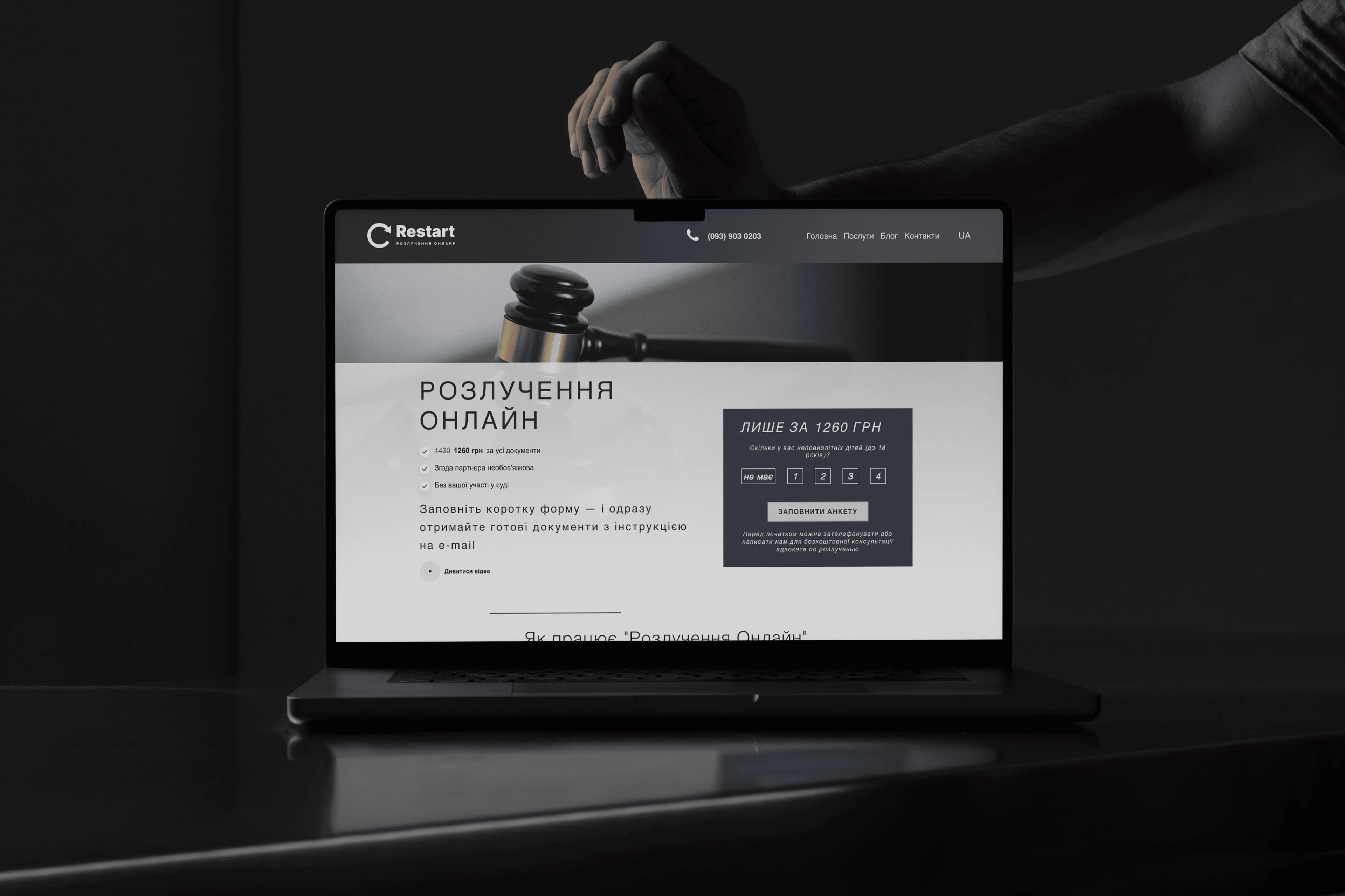
In legal services, people rarely “just read”. They’re looking for a fast, clear solution — without endless calls and back-and-forth questions. That’s why this case is not about another brochure website, but about a service that genuinely helps a client go from a Google search to a ready document.
This page showcases our project of building a corporate website for a lawyer focused on family law (divorce, alimony, property division). The task was demanding in the details: make the website generate inquiries and, at the same time, remove routine work from the lawyer — especially the repetitive filling in of claim forms.
RestartLaw is an example of a website that works like a mini product. It doesn’t just “tell” — it guides the user through a clear scenario: presents the service, answers common questions, collects data through a short questionnaire, enables payment — and as a result the client receives a ready document by e-mail. For the user it feels like a real service: fast, clear, and without the feeling of being sent in circles.
SEO in the legal niche is not about stuffing keywords. It’s about having dedicated pages for real client queries: online divorce, turnkey divorce, alimony, consultations, and more. People search for specifics — and land on a page where everything is laid out clearly: what’s included, how the process works, what information is required, and what they will get in the end.
A blog supports this strategy as well: it’s “the long game” for Google and a quick win for the client — because the articles answer typical questions in plain language. Plus, the blog strengthens expertise and trust — and without trust, conversion in legal services simply doesn’t work.
The strongest part of the project is automation. Here, a divorce scenario is implemented: the client doesn’t “dump documents into a messenger” and doesn’t try to explain everything by voice. They complete a short questionnaire — briefly and to the point. The system collects the necessary data and then generates a claim form (and other supporting documents) tailored to the client’s specific situation.
From the lawyer’s perspective, this is a key advantage: instead of spending time mechanically filling in templates, you receive structured, ready-to-use data that’s convenient to work with. And the client feels the process is “under control” — which greatly increases trust and willingness to pay.
This approach isn’t limited to divorce. We can implement a similar solution for any documents where fields repeat and there’s clear completion logic. For example: alimony claims, determining a child’s place of residence, property division, additional child-related expenses, applications/motions, complaints/claims, contracts, procedural documents, and more.
This is especially valuable if you handle many similar inquiries: the service removes chaos, saves time, reduces errors, and allows you to scale without “burning out on routine”.
In this case, we built the website like a funnel where each step makes sense. A person shouldn’t have to guess what to do next — they should see a simple path. That’s why we focused on:
• A questionnaire instead of dozens of messages: the client answers specific questions, and the system collects data “in the right order”.
• Automatic document generation: the output is a personalized package, not “here’s a template, figure it out yourself”.
• Turnkey logic: the website guides the client through the scenario — without distractions and without leaving them alone with the process.
• Service pages + blog for SEO: organic traffic growth and scalable content without “fluffy duplicates”.
• Trust: contacts, social links, status verification, clear terms — everything that removes the barrier “is this safe?”.
• Multilingual support: if the goal is a wider audience, it’s built in from the start.
Here’s an important nuance: in legal topics, people often visit from a phone, “in the moment”, when they need a solution quickly. If the website loads slowly or feels awkward on mobile, they simply close the tab. That’s why speed and responsiveness are not “nice-to-have” — they directly affect conversions.
We build the technical foundation so the site stays stable: optimized images, a clean page structure, logical headings, clear navigation, correct meta data, secure connection, and protection of key interaction points (forms, requests, data transfer). And just as important — the website can evolve: add new service pages, new blog posts, new automation scenarios without “rebuilding everything”.
RestartLaw is a results-driven case. The website doesn’t just “present the lawyer” — it helps the client take the first step easily and without pressure. At the same time, it removes routine work from the legal practice by automating document preparation. If you need a lawyer website or a legal website with the same approach — we’ll adapt the structure, content, and automation to your specialization and the types of claims you work with.

LegalTech case
Project overview
RestartLaw was developed as a working service: it explains a legal procedure, collects user data, supports document preparation and guides the client towards payment or consultation.
A legal process is complex for the customer but should not turn the website into an overwhelming instruction manual. The lawyer still needs structured information to prepare a claim.
We combined an SEO service structure with a step-by-step questionnaire, document generation logic and a payment flow. The user progresses consistently while the system collects the necessary information.
What we delivered
Business value
Useful resources
Delivery approach
We identified the audience, primary user scenarios and the information customers need before their first enquiry.
We planned the page hierarchy and content around a real action — selection, enquiry, purchase or consultation.
We combined a custom visual direction with responsiveness, performance and manageable functionality.
We verified key scenarios and prepared a structure that can continue to develop after launch.
Questions about this case
Reduce manual work and simplify client enquiries. We combined an SEO service structure with a step-by-step questionnaire, document generation logic and a payment flow. The user progresses consistently while the system collects the necessary information.
SEO structure for legal services and supporting pages; Step-by-step data collection for a legal claim; Automation for recurring legal documents; Payment flow and enquiry forms; Responsive interface designed around confidentiality
Yes. Structure, design and integrations are defined around the processes, audience and objectives of each business. This case demonstrates the approach rather than a reusable template.
Need a similar solution?
Complete the short quiz or explore other cases. To begin, it is enough to describe your business, main objective and the action customers should take.